Carbon credit ratings are one of the few independent checks a buyer has on a project. Each rating agency covers a different set of projects and uses its own methodology, so looking at just one agency’s ratings can give an incomplete picture of quality across the market.
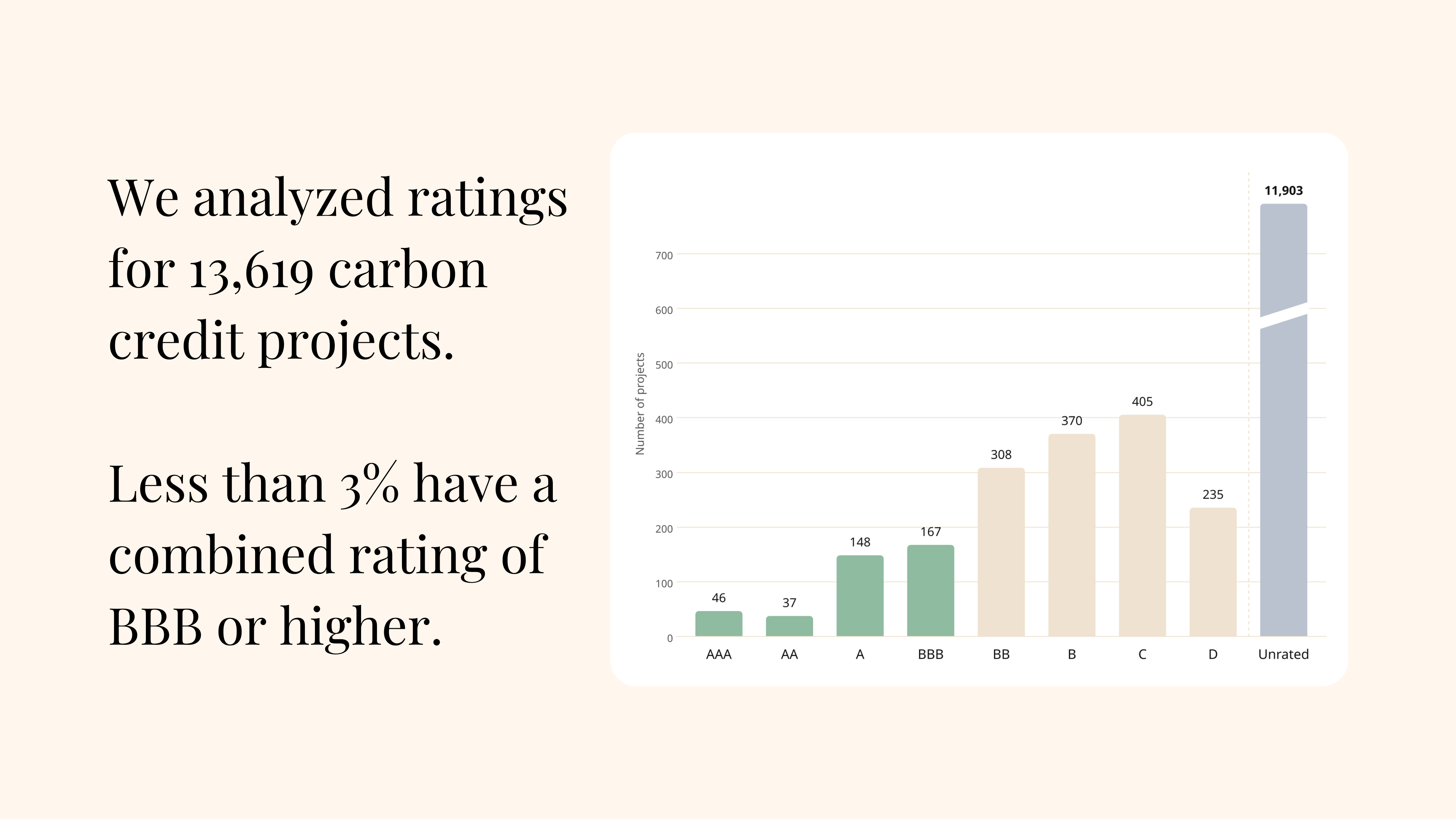
Our science team ran an analysis to get a fuller view. We combined the carbon credit ratings from the three major rating agencies, Calyx Global, BeZero and Sylvera, for every project that has issued credits. We found that most projects have never been rated, and of projects that are rated, less than 3% have a combined rating of BBB or higher. We're hoping that by sharing the results, buyers can get a complete picture of the projects that are out there.
How we ran the analysis
We started with the 13,619 projects tracked by AlliedOffsets that have issued credits. For each project, we pulled its ratings from Calyx Global, BeZero and Sylvera. Each agency uses its own letter scale, so we converted every rating to a number on one shared scale. Where more than one agency rated a project, we averaged those numbers into one combined rating. We then counted the results two ways: by number of projects and by number of credits issued. The full method is in the small print at the end of this post.
Most carbon credit projects have never been rated
Only 1,716 of the 13,619 projects (13%) have a rating from any of the three agencies. The other 11,903 have no independent rating. However, just because a project is unrated, doesn’t make it low-quality. Ratings are a useful starting bar, and for a project without one, it's important to do your own diligence.
Less than 3% of projects have a combined rating of BBB or higher
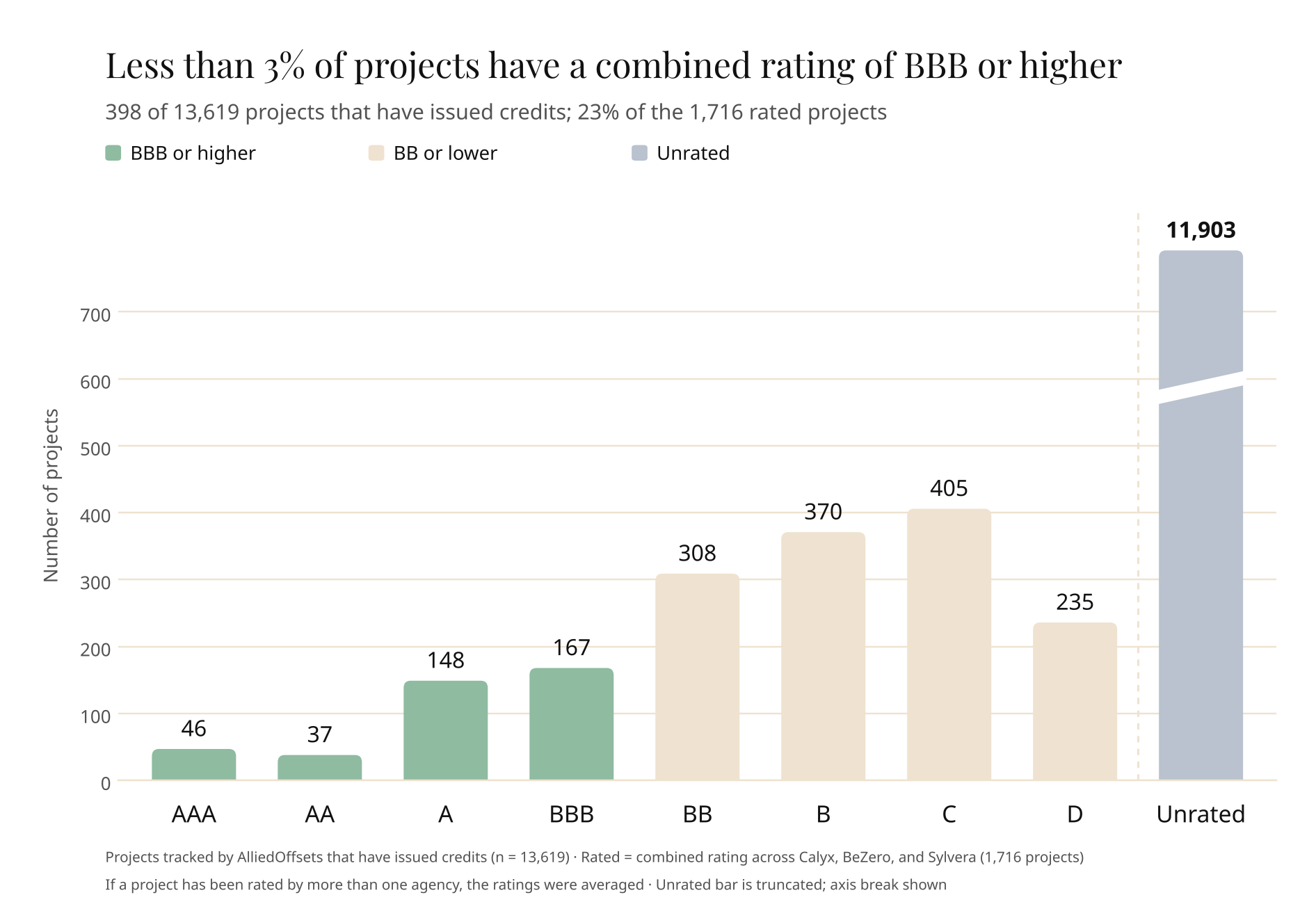
398 projects have a combined rating (the average of their agency ratings) of BBB or higher. That's 2.9% of all projects that have issued credits, and 23% of the projects that have been rated. The rest of the rated projects sit at BB or below, with C being the most common combined rating, with 405 projects. We use BBB as our baseline because it's typically the benchmark for investment grade carbon credits that are considered high-integrity and low-risk.
Low-rated projects issue more credits per project
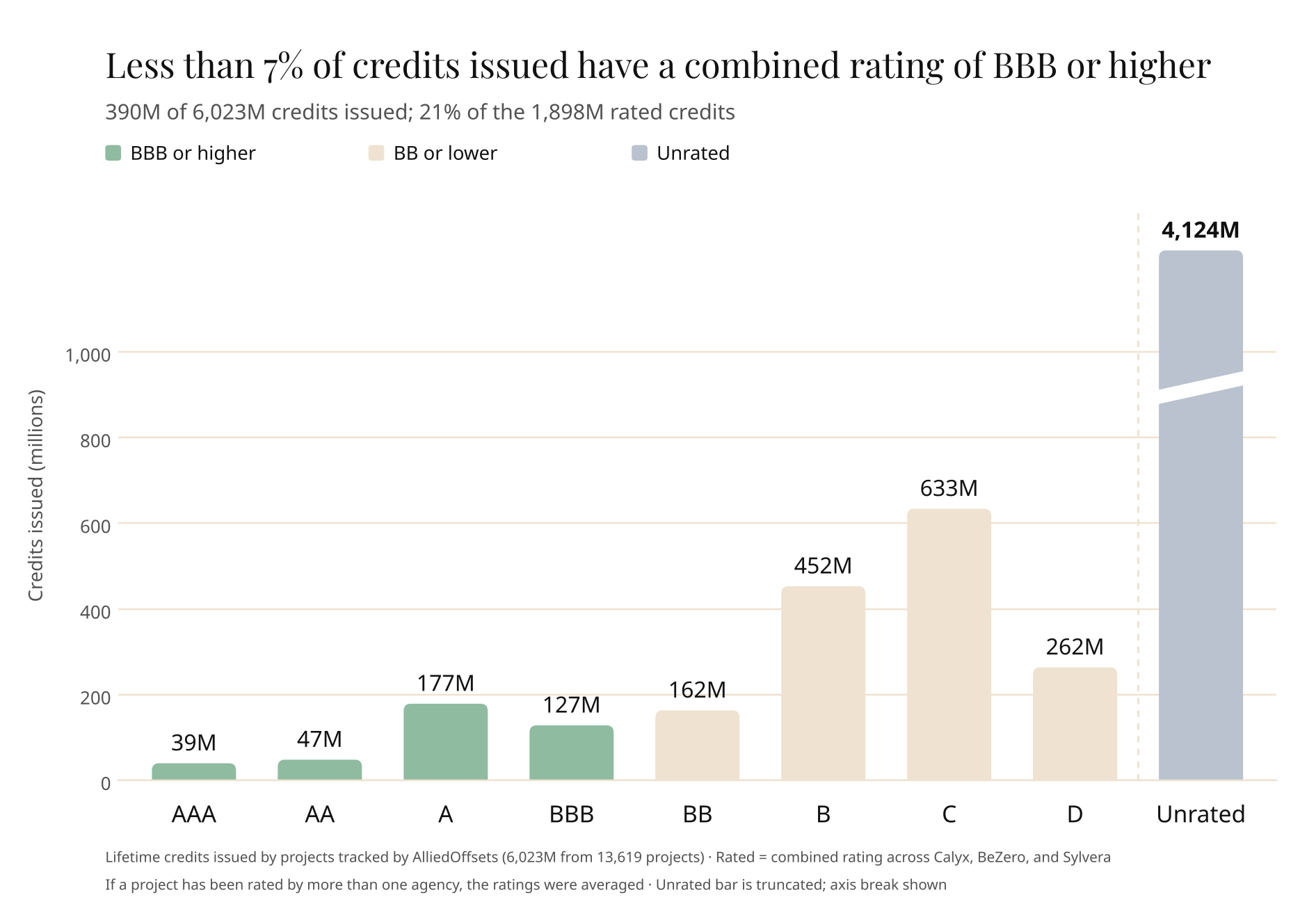
Counting credits instead of projects tells a similar story. The projects in the dataset have issued 6,023 million credits. Of those, 1,898 million come from rated projects, and 390 million come from projects with a combined rating of BBB or higher. That's less than 7% of all credits issued, and 21% of rated credits.
Projects with a combined rating of C have issued 633 million credits on their own, more than all the projects with a combined rating of BBB or higher put together. A buyer choosing from what's available on the market is far more likely to come across a low-rated credit than a high-rated one.
Both projects and credits are important; projects show how many unique options meet the bar while credits show how much of the supply they represent.
Quality varies by project type
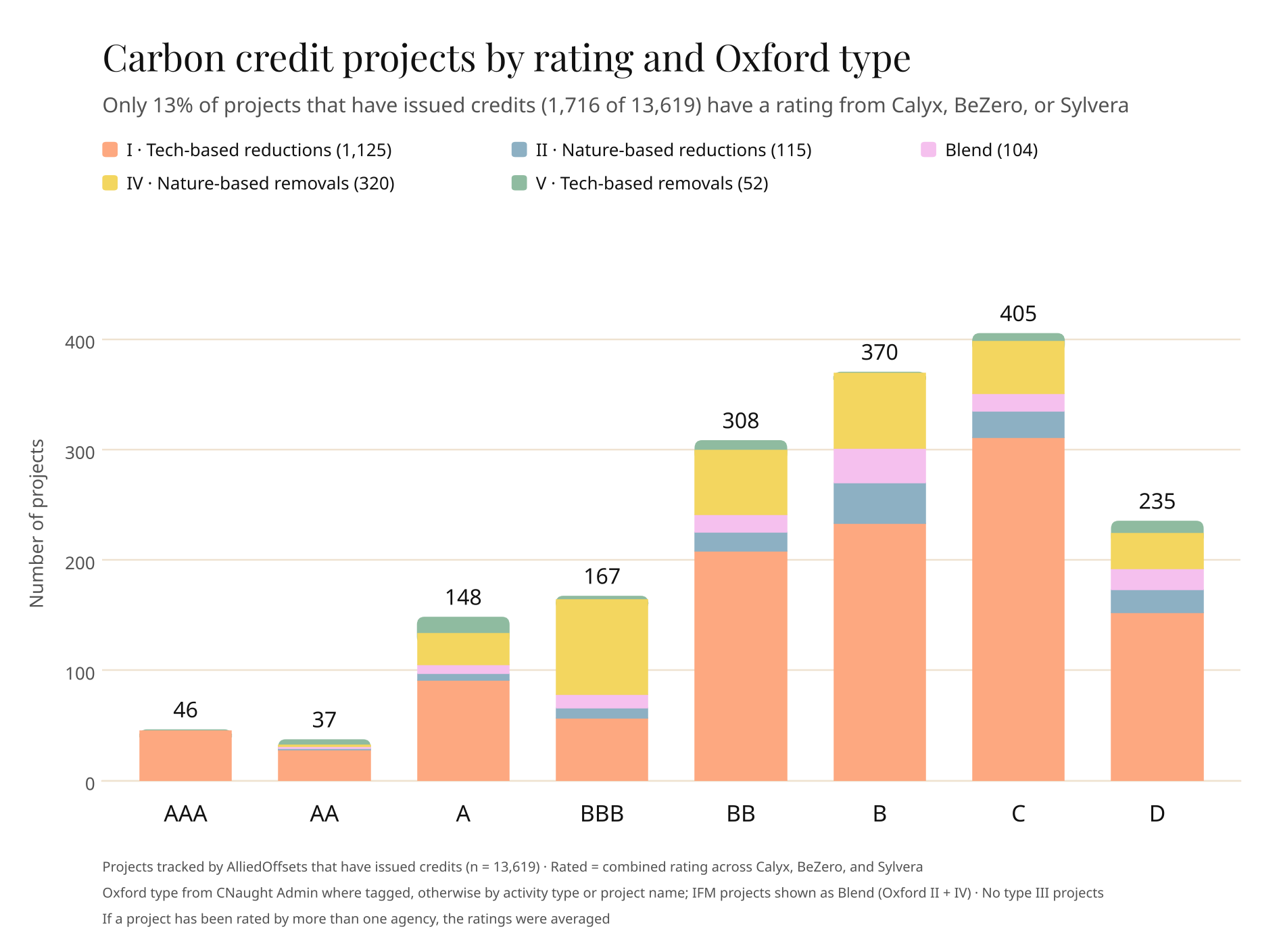
We also looked at the rated projects by project category, as defined in the Oxford Offsetting Principles. Technology-based emissions reductions make up most rated projects at 65%. Nature-based removals are the next largest group at 19%, followed by nature-based reductions at 7% and blended projects such as improved forest management at 6%. Technology-based removals are still a small group, representing just 3% of rated projects.
What to do when two rating agencies disagree
Because each agency uses its own methodology, the same project can receive very different ratings. Of the 536 projects rated by more than one agency, only 107 (20%) got the same rating from every agency, and 283 (53%) have ratings two or more levels apart (for example, BBB from one agency and B from another). 154 projects (29%) are rated BBB or higher by one agency and BB or lower by another. At CNaught, we don't automatically go with one agency's rating – when two ratings split, our science team looks at what's driving each rating. Then we do our own diligence to decide whether the project has a real concern, or whether one agency's methodology is too conservative for that kind of project. Some agencies are also stronger on certain project types, such as nature-based or technology-based projects, because their measurement methodologies differ. That's why we believe it’s important to use multiple rating agencies; one agency can catch a risk another misses, and comparing them shows us where a project needs a closer look.
Bottomland Forests of the Louisiana Plains is a good example. One agency rates it BBB and another rates it D, which brings its combined rating down to B. The difference in ratings is in part driven by the fact that only one agency reviewed direct attestations from landowners confirming they would keep logging without carbon financing. We see those attestations as strong evidence that the project is additional, so for this project we found the other agency's methodology more appropriate.
"Every rating agency has its own strengths, and they vary by project type. Looking at all three side by side, and then checking what's behind each rating, gives us a much clearer read on a project than any single score."
– Rachel Engstrand, Head of Science, CNaught
Why our platform doesn't list every project
A platform that lists every project, or even thousands of projects, leaves the diligence to the buyer. With 87% of all projects unrated and C the most common combined rating among the rest, we wouldn’t recommend the majority of projects that exist. Our platform purposely offers a short list for portfolio inclusion.
Our eligibility bar uses each agency's rating on its own, not the combined rating. A project is eligible for our science team's review if at least one agency rates it BBB or higher, and 518 projects (3.8%) clear that bar. That's slightly more than the 398 projects with a combined rating of BBB or higher, because it includes projects like Bottomland Forests, where one agency rates the project BBB and a lower rating from another agency pulls the combined rating down. Our science team then reviews each eligible project before it goes into a portfolio.
Why we show every rating, including the low ones
On our dashboard, customers can see every agency's rating for every project in their portfolio, even when a rating is low. We think showing low ratings, alongside our reasoning for why we agree or disagree, builds more trust with customers and it helps them understand why each project is in their portfolio.
What this means for carbon credit buyers
- Ask which agencies rated each project: Ask to see every rating, including any low ones
- Dig into disagreements: When ratings differ, ask what's driving the difference and what your provider considered
- Ask about unrated projects: Find out what diligence was done in place of an independent rating
- Ask how the list was narrowed: Find out what share of projects your provider turned down, and why
If you'd like to see the ratings behind your own portfolio, or learn more about how we vet projects, talk to our team.
Methodology: Data covers projects tracked by AlliedOffsets that have issued credits (13,619 projects and 6,023 million credits) as of October 2026. Ratings are from Calyx Global, BeZero and Sylvera. We converted each agency's rating to a number on one shared scale and, for projects rated by more than one agency, averaged them into a combined rating. Oxford type comes from CNaught's project records where tagged, and otherwise from activity type or project name. Improved forest management projects are shown as a blend of Oxford types II (nature-based reductions) and IV (nature-based removals). No rated projects fell into type III. The disagreement figures and the eligibility count (518 projects) use each agency's individual rating, not the combined rating.