
Sustainability leaders often ask us how energy attribute certificates (EACs) differ from carbon credits and when to use each. Under the GHG Protocol, the two play different roles in a company’s emissions inventory, and this guide explains how.
What are EACs?
An EAC represents one megawatt-hour (MWh) of electricity generated from a renewable source. EACs go by different names in different regions. In the US and Canada they’re renewable energy certificates (RECs), Europe uses Guarantees of Origin (GOs), and I-RECs are used in more than 50 countries.
When a company retires an EAC, it can claim that renewable generation as its own electricity use. A retired certificate can’t be resold.
What are carbon credits?
A carbon credit represents one tonne of carbon dioxide equivalent reduced or removed by a project, such as protecting a forest or capturing methane. Companies use high-quality carbon credits to address emissions they can’t yet cut.
How each one counts under the GHG Protocol
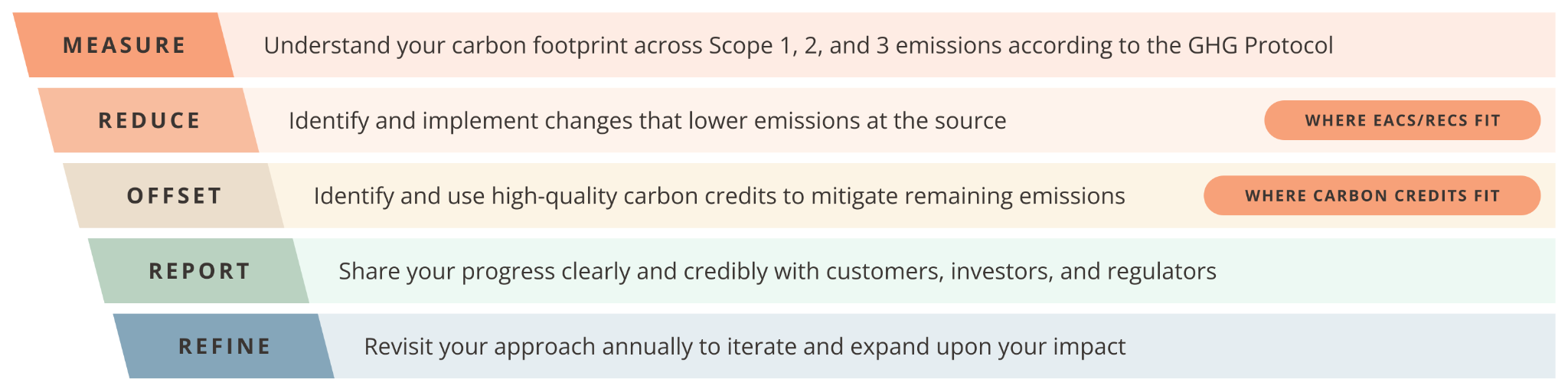
The GHG Protocol’s 2015 Scope 2 Guidance introduced the market-based method. It lets a company lower its reported Scope 2 emissions by buying and retiring EACs, power purchase agreements (PPAs), and other contractual instruments. Certificates should come from the same market where the company uses the power.
Carbon credits work differently. Companies can use them to address emissions in any scope, including Scope 2, but a company reports its emissions in full and reports the credits it retires separately. Credits can’t be subtracted from its emissions inventory. The Science Based Targets initiative (SBTi) takes the same approach in its Corporate Net-Zero Standard v2. Credits used for its Ongoing Emissions Responsibility recognition are not counted toward targets or netted from the inventory.
The GHG Protocol is revising its Scope 2 guidance. Its public consultation closed in January 2026, and no final date has been set.
How companies use EACs and carbon credits together
Many companies start with EACs for Scope 2, then use carbon credits for their remaining Scope 1 and 3 emissions. That split reflects how the standard counts each instrument, not which one has more impact.
Some argue that companies would get more climate impact by putting its whole budget into high-quality carbon credits, since credits must meet additionality requirements and can address emissions in any scope. We agree, but also understand that many companies follow the GHG Protocol and want to show Scope 2 reductions, which EACs allow under the current standard.
Quality differences between EACs and carbon credits
Carbon credits vary widely in quality, and two projects of the same type can deliver very different climate impact. That’s why it’s important to choose projects that pass a rigorous diligence screen, or to work with a vendor that diligences projects for you. At CNaught, fewer than 4% of projects are eligible for our portfolios. Our science team runs every project through our 7-step diligence process, which incorporates all major third-party rating agencies.
EACs are closer to a commodity, with much less variation in quality from one certificate to the next, so we rarely steer buyers toward one certificate over another. Green-e certification is a useful signal that a third party has certified a REC, which can give buyers extra confidence.
How Sycomp uses EACs and carbon credits together
Sycomp, an IT infrastructure and solutions company, shows how this works in practice. Its program started in 2020, when one of its largest customers added sustainability requirements to its master service agreement. Sycomp now measures its emissions against a 2021 baseline and has an SBTi target to reduce Scope 1 and 2 emissions 38% by 2030.
Sycomp reduces emissions where it can first. Its Burlingame Integration Center moved to 100% renewable energy through its local utility in 2023, and on-site solar there generated 48.34 MWh in 2024. For the emissions it can’t yet eliminate, Sycomp uses each instrument for the job the GHG Protocol assigns it:
- EACs for Scope 2: In 2026, Sycomp bought 605 MWh of RECs, matched to the markets where it uses electricity, to bring its market-based Scope 2 emissions to zero
- Carbon credits for Scope 1 and select Scope 3 categories: Sycomp addressed 1,734 tonnes of emissions with carbon credits from six projects, including methane abatement in Louisiana and landfill gas capture in Brazil, both regions where it operates
Read the full story: How Sycomp turned a customer’s supplier requirement into a competitive edge
How CNaught can help
We offer both EACs and high-quality carbon credits, so you can address your Scopes 1, 2, and 3 emissions with one provider. Every EAC we offer meets the GHG Protocol Scope 2 Quality Criteria and comes from a facility commissioned or repowered within the last 15 years. Green-e certified RECs are available for buyers who want third-party verification. Every carbon credit we offer comes from a project that is highly rated by at least one third-party rating agency and passes our 7-step diligence process, and is covered by the CNaught Guarantee.
If you have questions about where EACs or carbon credits fit in your climate strategy, talk to our team.