
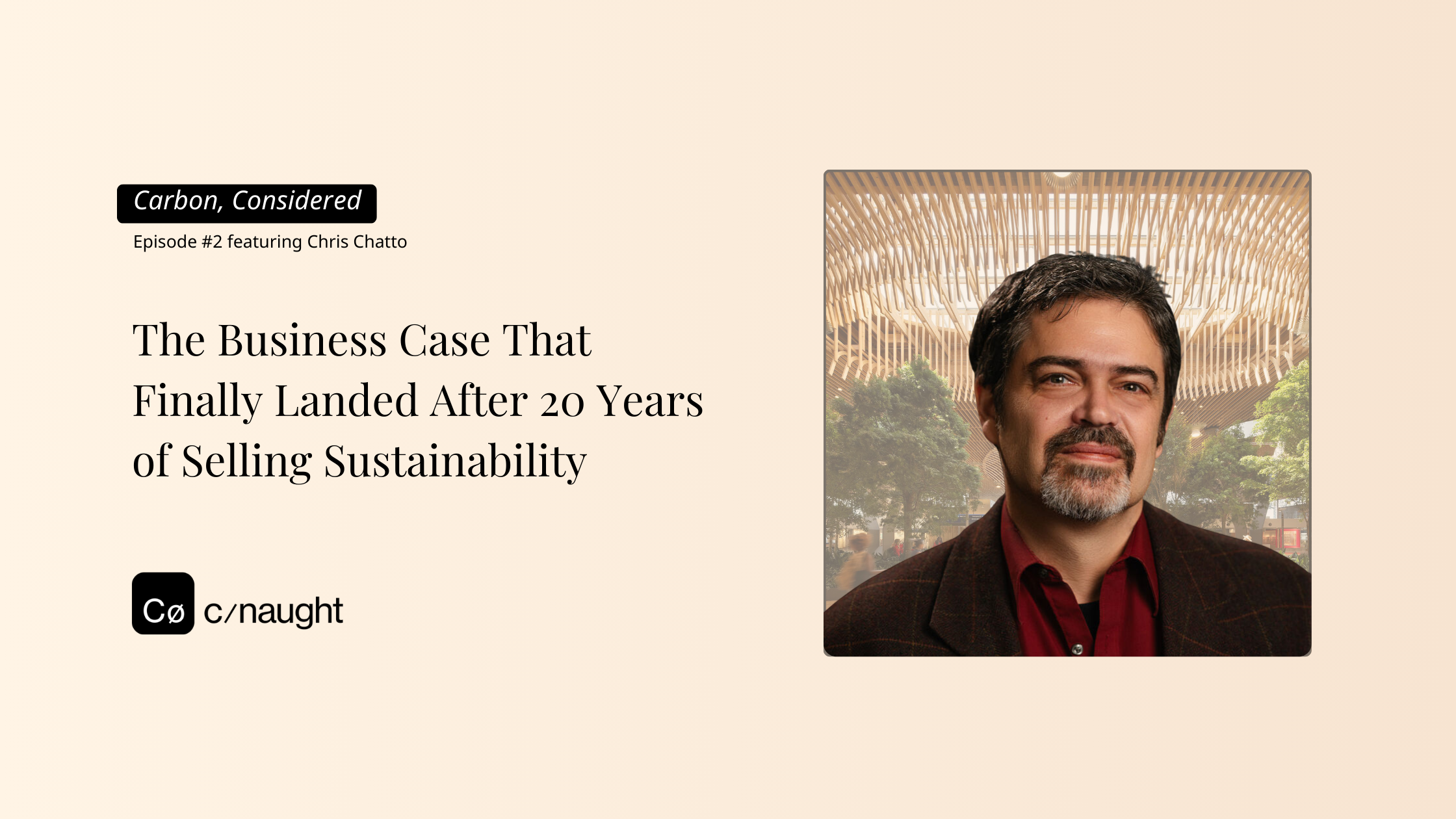
For 20 years, Chris Chatto has watched the sustainability pitch evolve. The arguments that work today aren't the ones he started with. Get the full episode →
When Chris Chatto started advocating for sustainable design at ZGF Architects, the conversation was about risk mitigation. LEED Silver won't break the budget. LEED Gold won't cost any more than Silver. It was incremental. Defensive.
Two decades later, the pitch has flipped. Chris told us:
"Now we have clients that have decarbonization commitments and are asking for zero-carbon projects. They may not know exactly what it means - but they're starting out at higher levels of sustainability. From my perspective, that's amazing."
Chris is a Principal at ZGF Architects, one of the largest architecture firms in the U.S., and co-chair of the AIA Large Firm Roundtable Sustainability Committee. He came to architecture through an unusual path: economics and finance at Wharton, a decade working for environmental nonprofits, and a master's degree at the University of Oregon - where he went specifically to focus on green building.
That analytical background still shapes how he thinks about sustainability. Not as a values proposition alone, but as a business case that has to actually land.
The arguments that changed
Early in his career, Chris spent most of his time trying to convince clients that sustainable design wouldn't hurt them. The pitch was defensive: it won't cost more, it won't slow you down, it won't be hard.
Building valuation. Developers now ask Chris for zero-carbon buildings not just because it's the right thing to do, but because they're thinking about resale. "My investors are concerned about what the value is if I try to sell a building that's a polluter 10 years from now," one client told him. "In a district that's starting to have decarbonization laws - where you couldn't even build a new building like that - do I want my polluting building on the marketplace?"
Workforce costs. For most institutional clients, the biggest line item isn't energy - it's people. And it turns out sustainable buildings help with recruitment and retention. "More sustainable buildings that have better daylight, better air quality, biophilia - people are more likely to stay and work at that place because they actually like the environment," Chris explained. "And it embodies what they want their employer to care about."
Patient outcomes. In healthcare - one of the most cost-conscious industries - the data started with a simple finding: patients who had a view of nature healed faster than those facing a brick wall. Faster healing means shorter stays, which means more capacity. "The hospital does better financially as people do better from a healing perspective," Chris said.
ZGF now designs hospitals that use 50% less energy than they did 20 years ago - and increasingly, they're fully electric.
"People would have said that wasn't even possible."
The pitch that now works
If there's a through-line in Chris's approach, it's this: don't try to create new problems for your client to solve. Tie sustainability to the commitments they've already made. He said:
"We're more successful when we say, 'We're not going to try to solve new problems for you - we're going to solve the problems you already have and the commitments you've already made, through your building. They've already committed to that. So there's a lot more success there."
It's advice that extends beyond architecture. Whether you're selling carbon credits, sustainable packaging, or any other climate solution - the path forward often isn't convincing someone to care about something new. It's helping them deliver on what they already said they'd do.
Why competitors collaborate
Chris also co-chairs the sustainability committee for the AIA Large Firm Roundtable - a group of 70 architecture firms that meet regularly to share sustainability strategies. Competitors, collaborating.
It sounds unusual. But Chris sees it as essential. He said:
"If one firm wins on sustainability, we all lose. This is something we're all in on together. It's not something that one firm can solve alone."
The architecture industry may be uniquely suited for this - collaboration is already built into how projects work, with multiple firms and engineering disciplines teaming up on a single building. But the principle holds more broadly: on sustainability, the rising tide matters more than any one company's edge.
Watch the full conversation
Chris's perspective offers something sustainability professionals across industries are hungry for: proof that the business case is finally landing - and a model for what to say when it does.
Watch the full episode to hear Chris on how energy codes are evolving (and why the U.S.'s patchwork system creates "hotbeds of innovation"), what advice he gives to students entering the field, and why embodied carbon is now the phrase on everyone's lips at Greenbuild.
Carbon, Considered is a monthly series from CNaught featuring conversations with sustainability leaders on what it really takes to drive impact. Fill out the form to watch the full episode - and be the first to know when new ones drop.
Looking to deliver on your own sustainability commitments? Learn more about CNaught's solutions for the built environment.
.png)
.png)