
.png)
When SBTi released its Corporate Net-Zero Standard Version 2.0 in June, we were glad to see it directly recognize carbon credits as a way for companies to take responsibility for their ongoing emissions. As we wrote at the time, it's now up to companies to do their part.
To make it easier for companies to get started with budgeting for the new standard and its recognition levels, we built the SBTi Ongoing Emissions Responsibility (OER) Calculator.
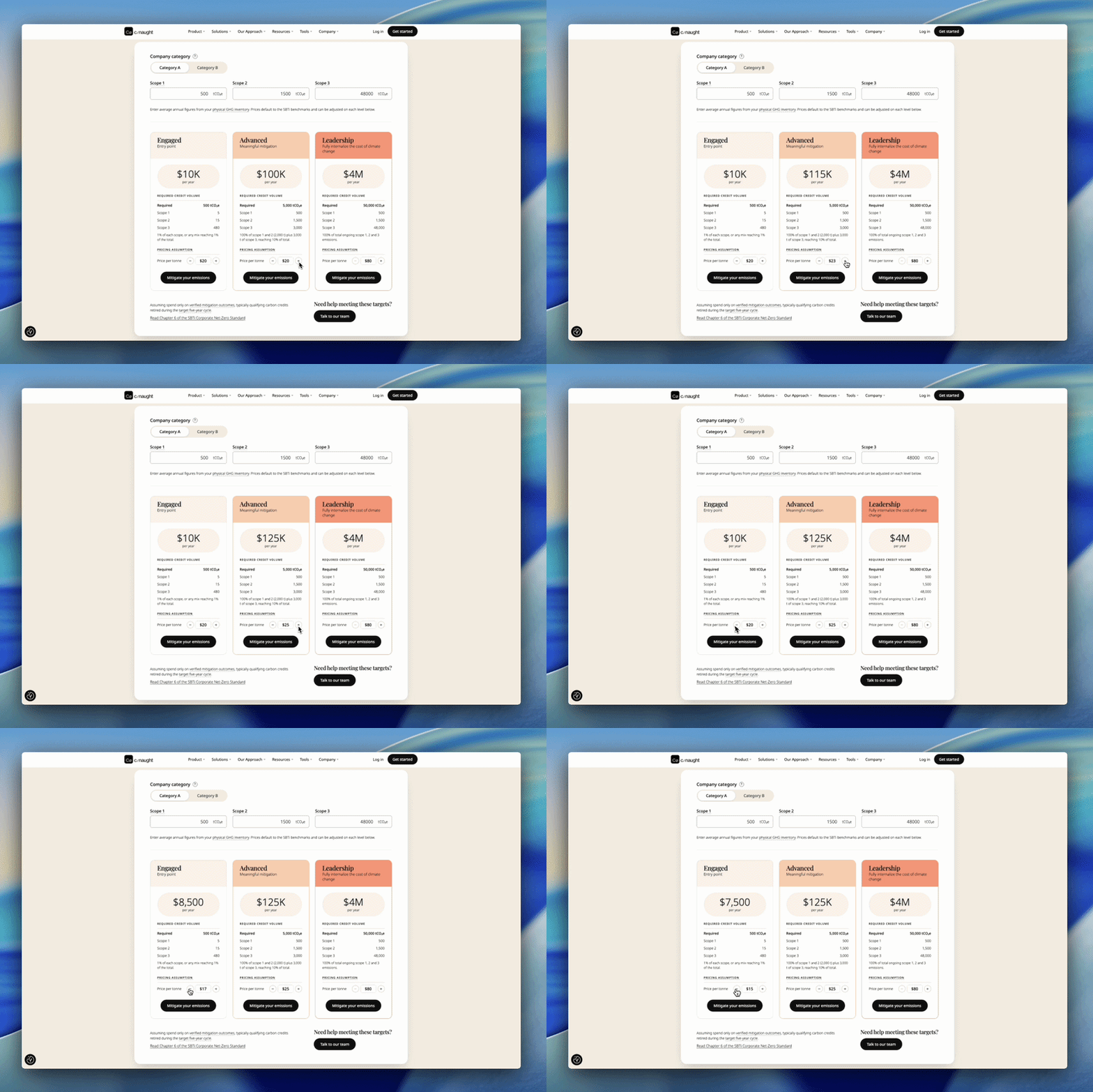
How it works
Pick your company category, enter your average annual Scope 1, 2, and 3 emissions from your GHG inventory, and you'll see an estimated annual cost for each level:
- Engaged: Cover 1% of total ongoing emissions; SBTi recommends $20/tCO₂e but sets no mandatory price at this level.
- Advanced: Cover 100% of Scope 1 and 2, plus enough Scope 3 to reach 10% of total ongoing emissions, at $20/tCO₂e.
- Leadership: Cover 100% of total ongoing emissions at $80/tCO₂e. Category B companies reach Leadership at 10% coverage with the same price.
Each level breaks the required credit volume out by scope, so you can see where the tonnes come from. The prices default to SBTi's benchmarks and can be adjusted at each level.
See an example
Take a Category A company with 50,000 tCO₂e a year: 500 tonnes Scope 1, 1,500 Scope 2, and 48,000 Scope 3.
The gap between Engaged and Leadership is wide by design. SBTi describes Leadership as fully internalizing the cost of climate change, and encourages every company to work toward it. For most companies, Engaged can be achievable and is a realistic place to start.
The bottom line
Even under V2.0, no company is obligated to take responsibility for its ongoing emissions until 2035. We can’t afford to wait that long. Our hope is that a clear number is one fewer reason to put this off.
If you want to talk through what a portfolio at your recognition level would look like, reach out to our team.
.png)
.png)
.png)