
When someone asked Charlie Brain what his wine company was doing about climate in 2019, he didn't have an answer. So he built a spreadsheet, Googled emissions conversion factors, and wrote a check to a recycling organization in Cape Town. It was carbon neutrality by hand, imperfect but intentional.
Six years later, Lubanzi Wines has one of the most comprehensive sustainability stacks in the industry and a carbon credit strategy built on third-party validation rather than guesswork. This is their story.
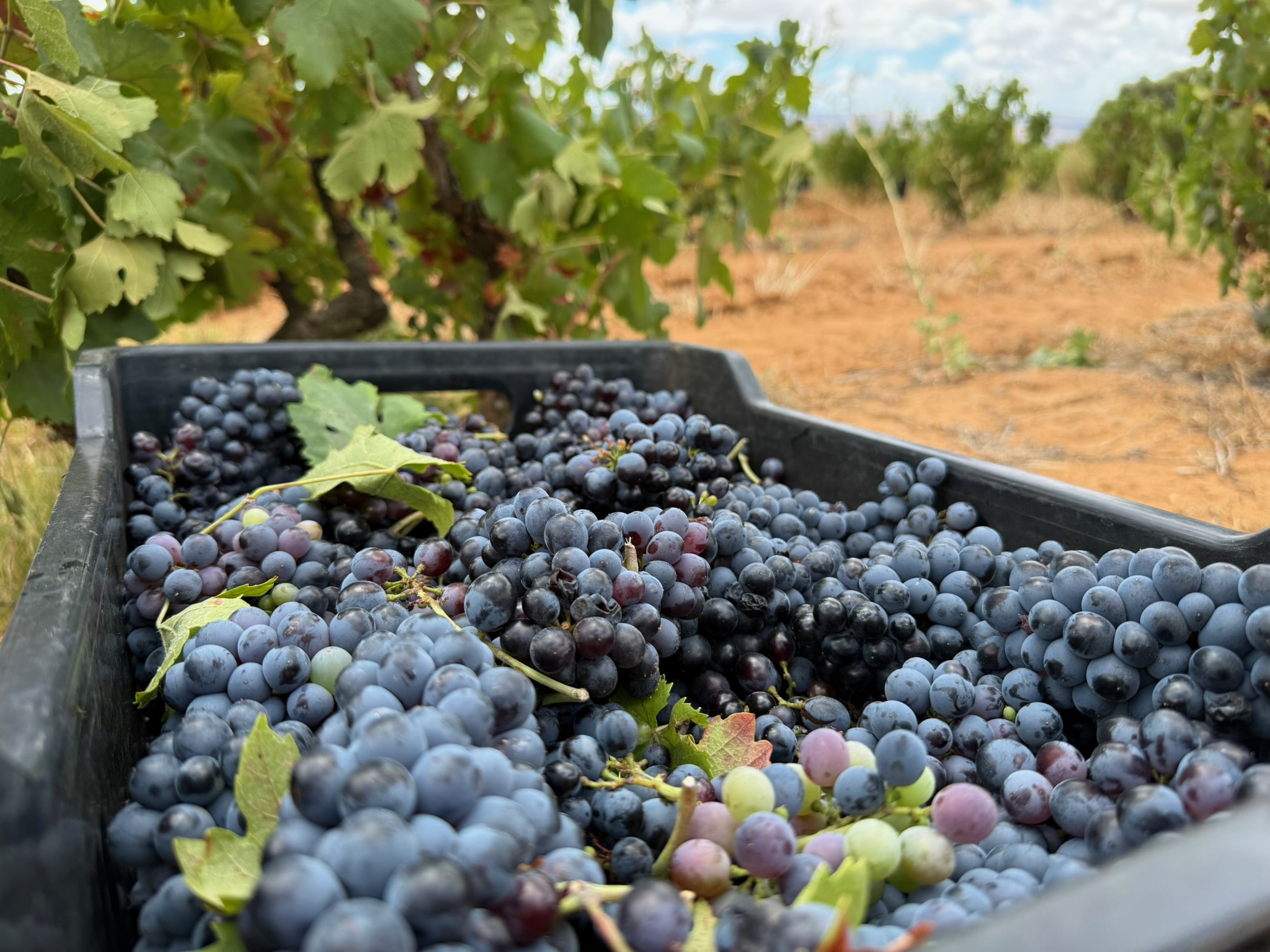
Lubanzi Wines is a South African wine brand built on the premise that business should give back more than it takes. Founded in 2016 by Charlie Brain and Walker Brown, Lubanzi splits 50% of its net profits with the Pebbles Project, a nonprofit providing healthcare and education to families on South African wine farms.
The company is certified B-Corp, Fair For Life Fair Trade certified, a 1% for the Planet member, and Climate Label certified. Their Shiraz is certified organic by Ecocert. You can find Lubanzi at Whole Foods, Trader Joe's, neighborhood wine shops, and restaurants across the US.
Oh, and the winery is named after a dog. A stray that followed Charlie on a 100-mile backpacking trip through South Africa and never left. Lubanzi is now the second most popular name for newborns in the country. (Not because of the wine. But Charlie appreciates the coincidence.)
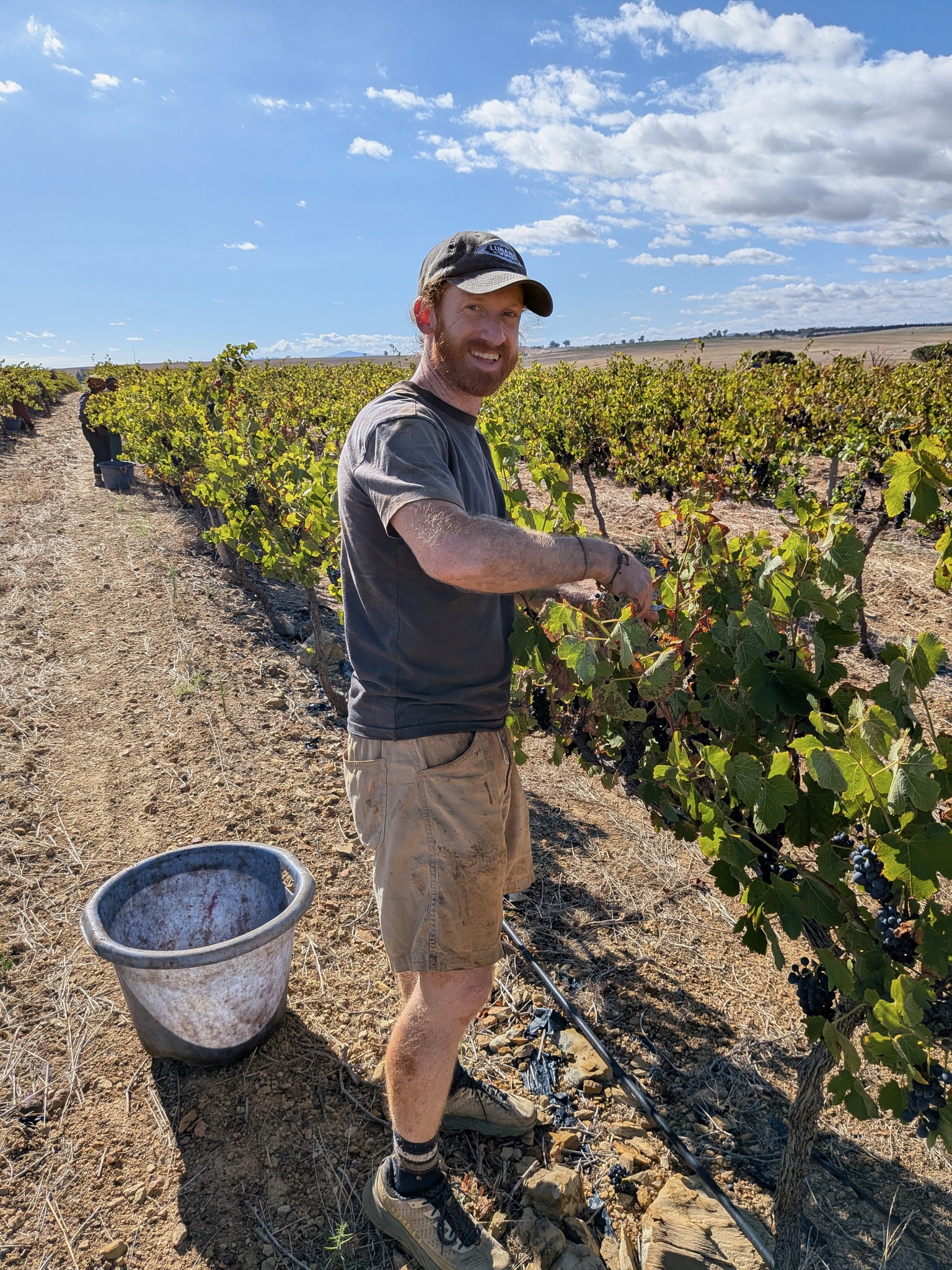
Climate wasn't part of the original plan. Lubanzi started with a social mission: fix the economic imbalance in South African wine, where brand owners capture the profit while farmworkers earn minimum wage. Fair trade certification, the Pebbles Project partnership, and the 50/50 profit split were all in place before anyone asked about carbon.
That question came in 2019. Someone asked Charlie what Lubanzi was doing about its environmental footprint. He didn't have an answer.
So Charlie built a spreadsheet. He Googled case studies to figure out how many kilograms of glass production translated to tonnes of carbon. He calculated flight miles, grape tonnage, shipping distances. The whole process took roughly 50 to 60 hours over the course of a month, a full working week for a CEO of a small wine company.
Then he took that number to a recycling organization in Cape Town and wrote them a check. An informal carbon credit, calculated by hand, purchased on faith. It worked as a starting point. But Charlie knew it wouldn't scale.
"We started asking ourselves - we drive to work, we operate a car, we have an office, we put things on gigantic boats that travel 8,000 miles across the ocean. We buy glass that's manufactured in Europe. You have to respect the fact that your business is having this impact on the planet and compensate for that in some way."
—Charlie Brain, Co-founder at Lubanzi Wines
The DIY approach had three problems.
First, measurement was time-consuming and unreliable. Charlie had no way to verify whether his spreadsheet calculations were accurate, and no benchmark to compare against. Every year meant rebuilding the math from scratch.
Second, credit quality was opaque. As Lubanzi learned more about the voluntary carbon market, the complexity became clear. Not all credits are created equal, and evaluating individual projects requires expertise most small businesses don't have. Charlie's initial strategy was to buy small amounts from many different providers to spread the risk.
"We used to try and spread it out, buy credits from like 20 different providers, a little bit from each one. That way we could do the least damage possible by buying the wrong one." It wasn't the best strategy."
Third, communicating credibly was difficult. Anyone can claim to be carbon neutral. Without third-party validation, those claims ring hollow, especially in an industry where consumers are increasingly skeptical of environmental marketing.
CNaught's CEO Mark Chen reached out to Charlie and asked: what carbon credits are you actually buying?
"The deeper you get into this industry, the more you find out how imperfect of a system it really is. It's so easy to just stop there and say you want nothing to do with it. But I think carbon neutrality is similar to engaging in business in South Africa. The moment you start saying you're carbon neutral, people start investigating that claim."
Charlie was looking for two things in a partner. First, transparency: an easily accessible model where anyone could quickly understand what they were doing and why. Second, genuine differentiation: credits and portfolios that were demonstrably different from what else was available, backed by rigorous evaluation.
Time savings. What once took 50 to 60 hours now takes a few. CNaught handles measurement, portfolio construction, and project-level due diligence, freeing Charlie to focus on running the business.
Confidence in quality. Instead of spreading purchases across 20 providers and hoping for the best, Lubanzi now invests in a single diversified portfolio that's been thoroughly evaluated against scientific best practices. Their portfolio includes technology-based reductions, nature-based reductions, and nature-based removals.
Credible communication. Lubanzi's CNaught impact page gives customers, importers, distributors, and retailers a single link to see exactly what they've purchased and why it matters. For a brand that's five layers removed from the person drinking the wine, that transparency is essential.
"We really lean on CNaught and on Change Climate to do that for us. Anybody can make a carbon credit claim. From a communications perspective, we lean on those two things. You don't need to believe us. These two people are the ones checking us to make sure what we're saying is real and legitimate."
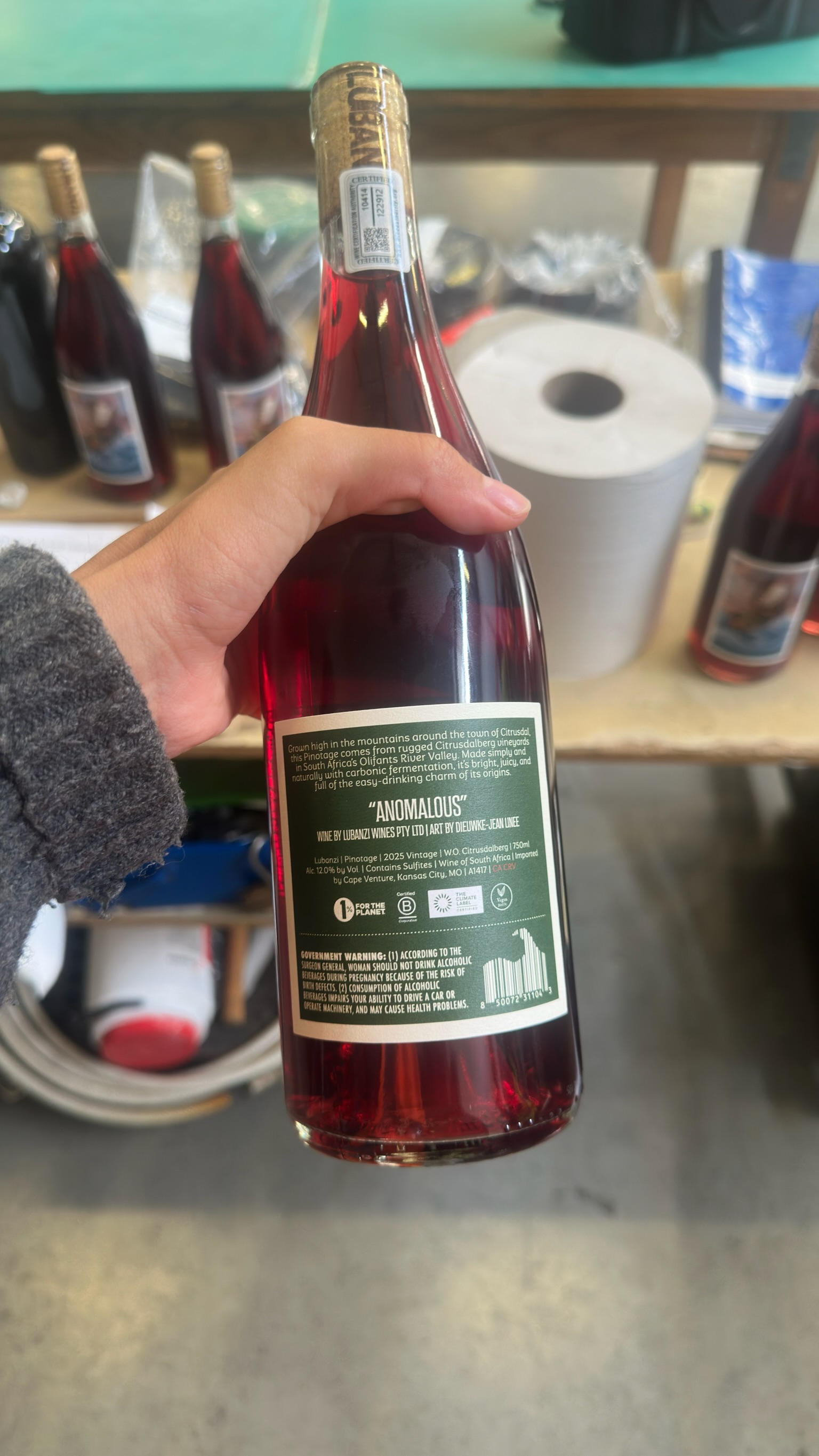
Lubanzi holds more certifications than most companies ten times its size. Each one tackles a different dimension of how the business impacts the world.
B-Corp provides a holistic roadmap covering governance, employee ownership, and stakeholder accountability. Fair For Life Fair Trade ensures that farmworkers have access to good working conditions and receive a premium above minimum wage. 1% for the Planet and carbon credits work in tandem, recognizing that the business impacts the environment and committing to offset that impact. Ecocert Organic certification addresses how the grapes are grown and what goes into the soil and into people's bodies.
"It's all so complex. The business and the product. I need different certifications to tackle different issues and to reassure people who are giving us their money that what they're choosing isn't just good for them, but good for all of us."
Charlie is candid about the tension. Not everyone responds positively to certification labels. Some consumers see the logos and develop an objection. But his view is long-term: "In time, in this industry, the good will be separated from the bad. As much as possible, try to be with the good ones, try to do the right thing, and hope that in the long run, it pays off."
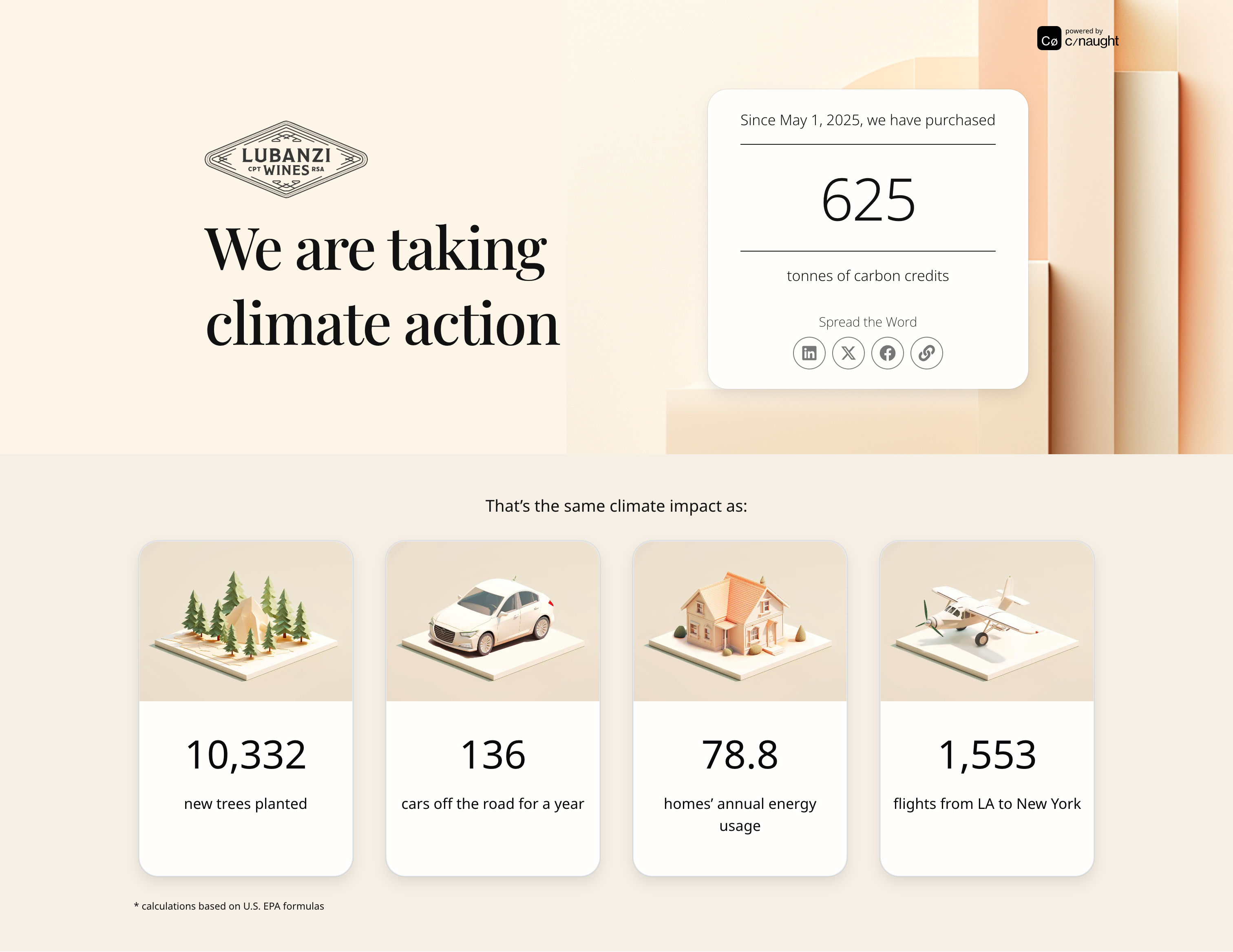
Since partnering with CNaught, Lubanzi has purchased 625 tonnes of carbon credits through a diversified portfolio. Their impact page shows the equivalent climate impact: over 10,000 new trees planted, 136 cars off the road for a year, and nearly 79 homes' annual energy usage.
Beyond carbon, Lubanzi has donated over $500,000 to the Pebbles Project since inception, with a goal of reaching $1 million. They've purchased over 2,100 fair trade tonnes and spent nearly $68,000 on direct environmental initiatives.
Charlie's advice for other small businesses is characteristically direct.
"Climate action is something that, believe it or not, we all have to do something about for our own sakes. Not even the next generation. Our own generation. Even if your business is just you on a laptop, you're making a real impact. It doesn't have to be difficult. It doesn't have to be a lot of time. You can do the right thing very simply by finding the right partners."
Lubanzi plans to keep making wine, keep finding people who appreciate what the brand stands for, and keep pushing toward that $1 million milestone with the Pebbles Project. In an industry where third-party certification is still far from the norm, Charlie sees Lubanzi's role as proof that doing the right thing and building a viable business aren't mutually exclusive.
"If you're going to do the right thing, you've got to communicate about it and be transparent about it. Otherwise, people may assume the opposite."
CNaught helps brands like Lubanzi meet the carbon credit requirements of B-Corp, Change Climate, and 1% for the Planet through a single diversified portfolio. If you're juggling multiple frameworks and want to simplify your approach, talk to our team.
.png)
.png)